I am continually amazed at the number of low-life characters that have crawled out from under their rocks to infest the internet with all manners of schemes and scams. I imagine these must be the types of people that would have been pulling telephone scams on old ladies back in the days before the internet.
Beyond the obvious crooks who are out there sending spam and phishing e-mail messages, there are other lesser-known idiots who are turning automated programs loose on the net in order to spread their garbage as far and wide as they possibly can by taking advantage of sites that have been set up for legitimate purposes.
These automated programs are commonly referred to as ‘spam bots’ and they roam the internet in search of forums and blogs where it is usually possible for almost anyone to post a comment to a blog or a forum discussion.
Since I manage a blog or two and also an active discussion forum, I have had a good deal of exposure to these rogue programs.
The idea behind these spam bots is not primarily intended to place ads in front of humans as much as it is to create links to other web sites. Every link that is found on the net that points to a certain site essentially gives that site a ‘vote’ when the search engines encounter these links. The more links pointing to a site, the better chance that site has to obtain a prominent listing in the search engines.
For example, consider two sites selling Viagra. One site does not use spam bots or any other techniques to generate links on other sites that point back to it. The other site makes use of spam bots to scour the internet and post spam messages in blogs and forums that contain a link back to it.
The site using the spam bots probably has a big advantage over the other site because the search engines have discovered all the links pointing to it from other sites all over the internet, and when someone goes to one of the big search engines and searches for ‘buy Viagra,’ the site with all the incoming links is likely to appear in the search results ahead of the site that has no incoming links.
This is not as straightforward as it sounds since there are many more factors that the search engines use to determine where sites are ranked and they are getting more sophisticated all the time.
Still, incoming links remain a powerful technique to boost a site’s rankings in the search engines, and the fact that there are still an endless stream of spam bots visiting my sites on a regular basis proves that beyond a doubt.
Fortunately for those of us that manage web sites, there are a variety of very effective tools available to combat spam bots.
Just about everyone has probably run into a ‘captcha’ form on a page at one time or another. This is one of those sections of a web site where you have to type in a series of numbers, letters or some other code before you are allowed to make a purchase, post on a blog or forum or use some other service available on a web site.
Since spam bots cannot read these codes due to the fact that they are presented as part of a graphical image, the spammers are not able to program their bots to successfully enter the required codes and the spam bot is stopped in its tracks when it encounters a captcha. And that’s a very good thing.
I do not use captcha forms on any of my sites and have instead decided to use some of the other tools that are generously developed by programmers and provided at no cost to anyone who cares to make use of them in the fight against spam.
On this blog I use a very simple and effective option that is provided by the program that controls the blog which does not allow any comments to be posted to the blog unless I approve them first.
When someone posts a comment here, the comments is held until I have reviewed it and determined that it is not spam.
This option can still present a problem since a large volume of spam comments will need to be reviewed one at a time to determine if they are legitimate, and that can take up a web site operator’s time.
Once again, another program comes to the rescue and identifies about 99% of spam that has been posted by spam bots and prevents it from ever making it to the list of posts waiting for approval. It holds them in a special area where I can review them at my leisure with a quick scan and delete them all with a single mouse click.
The combination of these two spam-fighting tools make the control of spam on my blogs almost effortless. I use similar tools on the discussion forum I manage with good results there as well, although a little more work is involved with an active forum.
What kind of crap are these spam bots attempting to spread all over the internet? Well, I will include some of it here just for your amusement. It is included below as a image which the search engines will not be able to read. I certainly don’t want them picking up links to these sites or associating any of this trash with my site.
Here is a very small sample of the trash that these spam bots have attempted to post right here on this very blog:
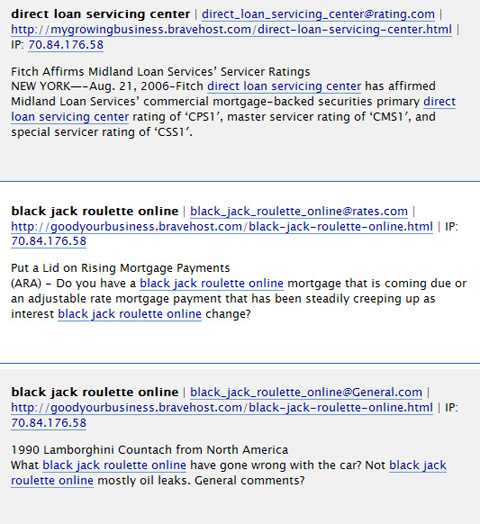
As you can see, one of the latest trends I have noticed lately is that they are using portions of legitimate news stories and including their links as part of the story. I am not sure if this is an effort to trick anti-spam programs or web site operators who the spammers presume are scanning through a lot of content trying to identify obvious spam content.
For the time being, the tools that are available have reduced the spam problem to a very easily manageable level for me. I know there are many different sites with many different requirements who may still have to devote more time to the fight against spam, but I am sure these tools help a great deal.
There are countless other nasty things going on around the net and I hope to devote some time to discussing some of them in the future.
[tags]spam bots[/tags]
Leave a Reply